Some flavour pairings you see coming a mile off — strawberry and banana, apple and cinnamon. And then there is passion fruit and blackcurrant. On one side, a bright, almost electric tropical fruit. On the other, a small dark berry from northern Europe, tannic and brooding. On paper, nothing suggested they belonged in the same cup. In the glass, it makes perfect sense.
Blackcurrant brings the backbone and the colour, passion fruit brings the lift and the acidity. Together they make a drink that does not need sugar to stand up on its own — which is rather the whole point. This article looks at what these two fruits genuinely offer nutritionally, then gets practical with three recipes: an iced frappé, a hot latte and a dessert mousse.
Blackcurrant: the underrated superfruit
We know blackcurrant as cordial, as liqueur, as jam. We know it far less for what it actually is: one of the most nutrient-dense fruits growing anywhere in northern Europe.
Its reputation rests first on its vitamin C content, which puts it among the best-endowed fruits of all — well ahead of the citrus you would instinctively think of. But what really sets blackcurrant apart is its concentration of anthocyanins, the polyphenol pigments responsible for its almost-black skin. They are also what explains the deep purple a blackcurrant drink takes on: the colour is not cosmetic, it is the visible signature of the antioxidant compounds in the fruit.
One more thing, often overlooked: blackcurrant is a European fruit. It grows in France, and it does not need to cross the planet to reach your cup. For a range built on being genuinely natural, that consistency matters.
Passion fruit: the lift
Passion fruit plays the opposite role. Where blackcurrant is dense and tannic, passion fruit is bright, sharp and instantly recognisable. It contributes vitamins C and A along with fibre, and above all that tropical note that stops the blend from turning austere.
It is a classic bit of kitchen balance: a base note and a top note. Blackcurrant alone would be too serious; passion fruit alone, too fleeting. Together, they hold the finish.
Date: the only sweetener, and why
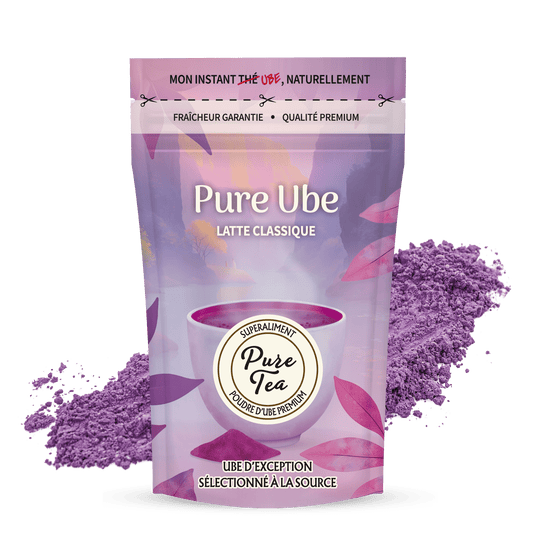
Pure Tea's Passion Cassis powder contains exactly three ingredients: passion fruit, blackcurrant, date. That is it. No added sugar, no flavourings, no colourings, no preservatives.
The date is not there by accident. Two fruits as acidic as blackcurrant and passion fruit need rounding off, or the drink nips. White sugar would do the job, but it would bring nothing else to the party. The date arrives with its fibre, its iron and a more gradual energy release — the sugar is still there, but it comes wrapped in the whole-fruit matrix, which changes how it behaves both on the palate and in digestion.
That is the logic behind the entire Fruity Latte range, with one exception: Fraise Tropicale, which manages without even the date, since banana and mango sweeten it well enough on their own.
Recipe 1 — Iced passion and blackcurrant frappé
This is the version we would push first from late summer into autumn. Cold tightens up the blackcurrant's acidity and makes the passion fruit read even more clearly. Five minutes, start to finish.
Ingredients (1 tall glass)
- 2 teaspoons Passion Cassis powder
- 200 ml milk, dairy or plant-based, well chilled
- 1 tablespoon warm water or milk, for mixing
- 6 to 8 ice cubes
Method
- Make a paste first. Tip the powder into the bottom of the glass or blender, add the tablespoon of warm liquid and work it until completely smooth. This takes twenty seconds and it decides everything: fruit powder thrown straight into cold liquid forms lumps you will never recover from.
- Add the ice and the cold milk.
- Blend for 20 to 30 seconds, until frothy and even. Without a blender, a cocktail shaker or a lidded jar shaken hard for half a minute does a very respectable job.
- Serve straight away, while the foam holds.
Three mistakes to avoid
Skipping the paste. By far the most common error, and the only one you cannot undo.
Guessing the dose. One teaspoon gives a light, gentle drink; two give a bold, deeply coloured frappé. A 50 g pouch covers 8 to 10 cups at one teaspoon, 5 to 7 at two — plenty of room to find your level.
Over-diluting. Past 200 ml per dose the blackcurrant drops away and you are left with faintly tinted milk.
Recipe 2 — Hot passion and blackcurrant latte
Same powder, entirely different register. Hot, the acidity softens and the date notes come forward clearly. This is the end-of-evening version, helped by the fact that it contains no caffeine whatsoever — you can drink it at nine at night without consequence.
The principle is the same: work 1 to 2 teaspoons into a smooth paste, then top up with 150 to 200 ml of hot milk. One point deserves emphasis: never let the milk boil. Aim for 65 to 70 °C at most. Beyond that, two things happen — plant milk tends to split on contact with the blackcurrant's acidity, and the fruit's heat-sensitive compounds degrade. Milk taken off the heat at the first small bubbles around the edge is exactly right.
A handheld frother will do for the foam, but it is not the only route: we have set out five ways to froth a latte without a machine, from the shaken jar to the electric whisk.
Recipe 3 — Passion and blackcurrant mousse
This one leaves the cup behind. Fruit powder behaves beautifully in baking, provided you give it some fat to cling to.
Whip 200 ml of well-chilled plant cream (coconut or barista oat, ideally) to soft peaks. In a separate bowl, work 2 teaspoons of Passion Cassis powder into two tablespoons of the still-liquid cream until smooth and free of grit. Then fold that base into the whipped cream with a spatula, in three additions, using broad folding movements. Chill for at least an hour.
What you get is a mousse in a striking pinkish-purple that owes nothing to any colouring. It also makes an excellent cupcake frosting base, or a middle layer in a panna cotta. For other cold uses across the range, our homemade ice lollies take very well to the same treatment.
Which milk for a fruit latte?
The question genuinely matters with passion and blackcurrant: it is the sharpest in the range, and milks do not all cope the same way.
- Oat — the all-rounder. Rounded, faintly sweet, it froths well and takes the acidity in its stride. The default choice.
- Coconut — pushes the blend towards the tropical. Excellent iced, more divisive hot.
- Almond — light, and it leaves the blackcurrant right at the front. Go for this if you want the fruit and nothing else.
- Soya — the highest in protein, so the best for a dense foam. The catch: it is also the quickest to split if the milk gets too hot.
- Cow's milk — unsurprisingly, it works very well, semi-skimmed especially.
Our comparison guide to plant milks for lattes goes into the detail on textures and temperatures.
Storing fruit powder
A 100% fruit powder has no preservatives and no anti-caking agent. That leaves it sensitive to two things: moisture and light.
Reseal the pouch carefully after each use, press the air out, and keep it in a dry cupboard away from direct sunlight. Above all, never use a damp spoon: a few drops are enough to set the whole thing solid. And skip the fridge — the condensation every time you take it out does precisely the opposite of what you want.
Where does Passion Cassis sit in the range?
It is the most premium of the five Fruity Lattes, at €10.90 for a 50 g pouch, and the one with the most character. If you are torn: Fraise Tropicale is the crowd-pleaser and the one children go for, Banana Spéculoos is the comfort choice, and Pumpkin Spice Latte is the autumn classic — we compared its make-up against the PSLs sold in coffee shops, and the gap is startling.
Passion Cassis, for its part, is for people who want a drink with some backbone. It is also one of the more interesting caffeine-free alternatives in the catalogue, precisely because it is not trying to imitate coffee.
Frequently asked questions
Does Passion Cassis contain added sugar?
No. The only sugars present are those naturally found in the three fruits: passion fruit, blackcurrant and date. No sugar, syrup or sweetener is added. A 200 ml serving provides roughly 11.61 kcal, based on 3 g of powder in water.
Can children drink it?
Yes. The powder contains no caffeine and no additives. That said, passion and blackcurrant is sharper than the rest of the range: for younger palates, Fraise Tropicale or Banana Spéculoos usually go down better.
How many cups per pouch?
A resealable 50 g pouch makes 8 to 10 cups using one teaspoon, or 5 to 7 cups using two.
Are there any allergens?
The powder itself contains only passion fruit, blackcurrant and date. It is packed in a facility that also handles nuts, milk and gluten, which anyone affected by those allergens should take into account.
Can the frappé be made in advance?
It keeps for 24 hours in the fridge, but the foam collapses and slight separation appears. Shake before serving. For the best result, make it fresh.
Is it vegan and gluten-free?
Yes, the powder is vegan and gluten-free, made in France, with no artificial flavourings, colourings or preservatives.
In short
Passion and blackcurrant is not the obvious fruit latte, and that is exactly what makes it worth your time. Three fruits, no added sugar, a colour that comes purely from the blackcurrant's anthocyanins, and three different preparations from a single pouch. Start with the frappé — it shows off best what these two fruits can do together.