When the thermometer goes wild, even the most devoted matcha latte drinkers put their whisk away. Good news: your favourite powders turn into creamy, colourful homemade popsicles that beat anything from the supermarket freezer — no ice cream maker, no additives, and little to no added sugar. Matcha, ube, coconut, raspberry, rooibos: here are 5 tried-and-tested recipes, starting with the golden rule that separates a sad ice cube from proper creamy ice.
Why make your own popsicles?
Take a look at a shop-bought popsicle label: glucose-fructose syrup, flavourings, colourings, emulsifiers. Make them yourself and you choose every ingredient — a milk (plant-based or not), a fruit, a quality powder like those in our Matcha & Ube collection — and nothing else. It's also about flavour: ube naturally brings vanilla and hazelnut notes, matcha its noble bitterness, raspberry its zing. And it's budget-friendly: a batch of 6 costs barely more than a single artisan popsicle from the gelato shop.
If you already love our summer iced lattes, you have everything you need in the cupboard: these recipes are, at heart, their bite-sized cousins.
The kit: no ice cream maker required
Here's the pleasant surprise: no ice cream maker needed. All you need is:
- popsicle moulds (silicone or stainless steel, 6–8 cavities of 80–100 ml);
- wooden sticks if your moulds don't include them;
- a blender or immersion blender for a perfectly smooth base;
- and for matcha, ideally a bamboo chasen to dissolve the powder lump-free before blending.
Allow 10 minutes of prep and at least 6 hours in the freezer — overnight is even better.
The anti-crystal golden rule: a rich, creamy base
A popsicle turns crunchy and watery when free water in the mix forms large ice crystals. To avoid that without industrial emulsifiers, you need fat, fibre or natural creaminess. Three bases work every single time:
1. Full-fat coconut milk
Its good fats give the closest texture to real ice cream. It's the base of our matcha-coconut and ube-coconut recipes.
2. Greek yoghurt
Thick and slightly tangy, it adds protein and a frozen-yoghurt freshness. Perfect with berries.
3. A very ripe banana
Blended, it sweetens and binds the mix all by itself: the ally of truly no-added-sugar versions.
One last reflex: taste your base before freezing. Cold dulls sweetness — the mix should taste slightly too sweet at room temperature.
Recipe 1 — Matcha-coconut popsicles, the signature
The perfect balance between the grassy notes of ceremonial matcha and the sweetness of coconut milk. For 6 popsicles:
- 400 ml full-fat coconut milk
- 2 tsp (4 g) matcha
- 2 tbsp maple syrup (or 1 ripe banana for the no-added-sugar version)
- 1 pinch of sea salt
Method: whisk the matcha with 3 tbsp of warm coconut milk until fully dissolved, using a chasen or a small whisk. Add the remaining coconut milk, maple syrup and salt, then blend for 30 seconds. Pour into the moulds, insert the sticks and freeze for at least 6 hours. For a gelato-shop finish, drizzle with melted white chocolate just before serving.
Recipe 2 — Ube vanilla, the ice-cream flavour
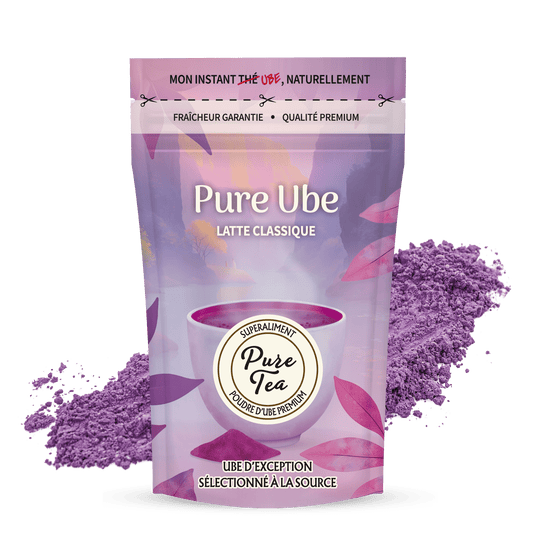
If you only make one: Pure Ube Vanilla powder already tastes like vanilla ice cream, with that spectacular purple colour thrown in. Blend 350 ml whole milk (or oat drink), 100 g Greek yoghurt, 2 tbsp ube vanilla powder and 2 tbsp honey. Freeze. The result is uncannily close to Filipino ube ice cream — to learn all about this tuber, revisit our ube latte guide.
Recipe 3 — Ube coconut, the tropical escape
The star duo of Filipino desserts. Blend 400 ml full-fat coconut milk with 2 tbsp Pure Ube Coconut and 1 ripe banana. Pour, freeze, close your eyes: you're there. Tip: sprinkle toasted coconut flakes into the bottom of the moulds before pouring in the base.
Recipe 4 — Raspberry-ube marble, the show-stopper
Prepare two bases: on one side, 200 g raspberries blended with 100 g Greek yoghurt and 1 tbsp honey; on the other, 200 ml milk with 1 tbsp Pure Ube Raspberry. Pour them into the moulds in alternating layers, then draw a wooden skewer through once to marble. Pink on purple: the effect is stunning. Fruit lovers will find more ideas in our Fruity Latte collection.
Recipe 5 — Rooibos-peach, the infusion popsicle
Proof that an infusion makes great ice too. Steep 3 tbsp of rooibos in 300 ml barely simmering water for 10 minutes, just like for a homemade iced tea. Let it cool, then blend with 2 ripe peaches and 100 g Greek yoghurt. Naturally caffeine-free, this one is perfect for kids and evenings alike.
Our tips for perfect popsicles
Unmoulding without breakage
Run the mould under lukewarm (not hot) water for 10 seconds, then pull gently on the stick while rotating slightly. If it resists, don't force it: give it 10 more seconds under the water.
Storage
Unmould the whole batch at once and store the popsicles in an airtight box, separated by baking paper. They keep for 2–3 weeks in the freezer — beyond that they're still safe, but the flavours fade.
The “latte pop” version
Any of our latte bases works: leftover prepared Pure Ube Latte, a well-steeped chai, or even a bubble tea base without the pearls all freeze beautifully. Browse the Our Ube collection to vary the colours.
Frequently asked questions
How do you avoid ice crystals in homemade popsicles?
Use a rich base (full-fat coconut milk, Greek yoghurt or blended banana), blend finely and freeze fast at -18 °C. The richer and creamier the base, the less free water there is to form crystals.
How long do homemade popsicles keep?
2–3 weeks in an airtight box in the freezer. Without industrial stabilisers they stay safe to eat longer, but lose aroma and creaminess.
Can you make them without popsicle moulds?
Yes: small cups or glass yoghurt pots do the job. Cover them with cling film and push the stick through the centre of the film so it stands upright.
Does matcha keep its benefits once frozen?
Yes — cold preserves matcha's catechins and L-theanine very well. It's prolonged heat, not freezing, that degrades its antioxidants.
Can these recipes be made with no added sugar?
Absolutely: swap the honey or maple syrup for a very ripe blended banana, or dates. The ube vanilla and ube coconut versions lend themselves especially well, as the powder already brings its own gentle sweetness.