That beautiful, velvety foam crowning coffee shop lattes? You don’t need a €500 machine to get it. Here are 5 simple methods to froth your milk (or your latte) at home, along with all the tips for a perfect texture.
Foam is what turns a drink into a latte: it adds creaminess, roundness, and that irresistible look. The good news? Several budget-friendly methods deliver excellent results. Let’s review them, from the easiest to the most precise.
1. The jar (the zero-budget method)
The simplest method: pour your milk (no more than halfway full) into a jar with a tight-fitting lid, close it, then shake vigorously for 30 to 60 seconds. The milk will double in volume. For hot foam, remove the lid and microwave the jar for 30 seconds: the foam will stabilize and rise. Ideal when you don’t have any tools.
2. The whisk
A simple kitchen whisk does the job: heat the milk, then whisk briskly back and forth. Less airy than the other methods, but effective and always within reach.
3. The handheld electric frother
This small battery-powered whisk (just a few euros) offers the best value for money: dipped into hot milk, it creates a fine, dense foam in 20 seconds. The must-have tool for homemade latte lovers.
4. The French press
Barista tip: pour hot milk into a French press (up to one-third full), then move the plunger up and down about twenty times. The mesh creates a remarkably creamy foam, perfect for latte art.
5. The bamboo whisk (chasen)
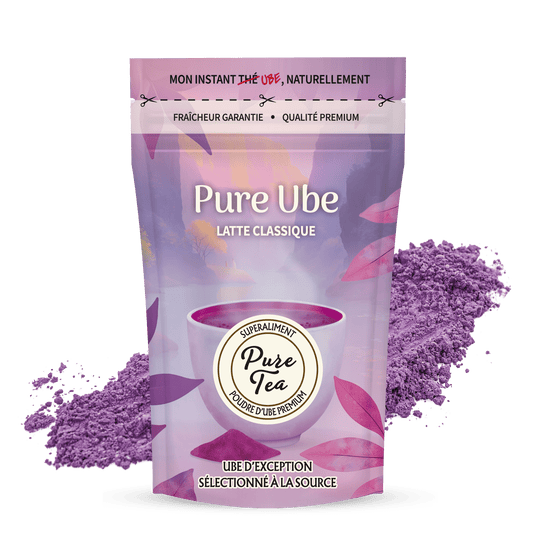
Essential for matcha, the bamboo chasen is also perfect for emulsifying a drink. For a matcha or ube latte, it’s the ideal tool: it creates a fine foam while dissolving the powder. Find it in our accessories section.
Which milk froths best?
The method matters, but the milk matters even more:
- Barista oat milk: the champion of plant-based milks, with protein and fat levels adjusted for a stable foam.
- Whole cow’s milk: very easy to froth, with a dense and long-lasting foam.
- Soy milk: froths well thanks to its protein content.
- Regular almond / coconut: more temperamental; choose the “barista” versions.
Hot foam or cold foam?
For a hot latte, froth warm milk (but not boiling, 60–65°C). For an iced latte, “cold foam” is made by frothing cold milk with an electric frother or in a jar: it sits nicely on iced drinks and creates a striking effect.
Common mistakes to avoid
- Filling the container too much: milk needs room to expand.
- Boiling the milk: above 70°C, the foam collapses and the taste changes.
- Using skim milk without adjusted proteins: the foam won’t hold well.
- Waiting too long: pour the foam right away, before it starts to fall.
Once you’ve mastered the technique, apply it to your favorite drinks: our matcha latte or our ube latte will be all the better for it.
Frequently asked questions
How do you froth milk without a frother?
The jar method is the easiest: pour the milk halfway up, close it, and shake for 30 to 60 seconds, then microwave for 30 seconds for hot foam. A whisk or a French press also works very well.
Which plant-based milk froths best?
Barista oat milk performs best: its protein- and fat-rich formulation gives a stable, creamy foam. Soy also works well.
Can you make cold foam?
Yes: froth cold milk with an electric frother or in a jar. Cold foam holds well on iced drinks and is perfect for iced lattes.
Why does my foam fall so quickly?
Usually because the milk is too low in protein, too hot (boiled), or served too late. Choose the right milk and serve immediately.
Time to whisk
Jar, whisk, frother, plunger, or chasen: everyone has their own method for coffee-worthy foam. Equip yourself with a bamboo whisk and turn your drinks into truly homemade lattes.