You've seen this purple powder somewhere — on an Instagram feed, in a coffee shop window, or while trying to work out what an “ube latte” actually was. Then the coconut version turned up, and the question followed: what exactly is it, and what does the coconut change compared with plain ube?
Short answer: the ube brings the colour and a soft, nutty flavour; the coconut brings the roundness and the tropical edge. The long answer, with two precise recipes and the exact composition, is below.
Ube Coco: what exactly is it?
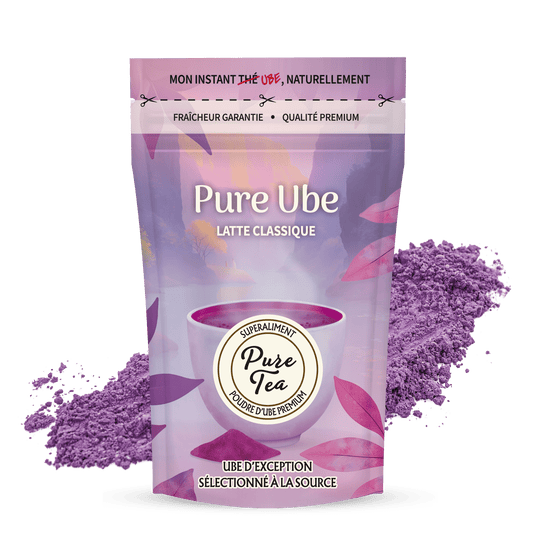
Ube Coco is a ready-to-mix purple powder made of two things: ube powder and a natural coconut flavouring. Nothing else. It dissolves in water or milk for a latte, and works as-is in baking.
Start with the ube
Ube (say “oo-beh”) is a purple tuber from the Philippines, where it has been a pillar of the dessert tradition for generations. It is not taro, and it is not purple sweet potato — it's a yam in its own right, Dioscorea alata.
The taste tends to surprise people on the first sip: not fruity, but milky and gently nutty, with a natural sweetness and a texture that fills the mouth. The purple owes nothing to a colouring — it comes from anthocyanins, the same antioxidant pigments found in blueberries and red cabbage.
Nutritionally, ube naturally provides vitamins C, A and E, along with potassium, iron and calcium. And crucially: no caffeine at all. It's a drink you can serve in the evening, or to children, without a second thought.
What the coconut is doing there
Ube on its own is good but reserved. Its nutty sweetness sometimes lacks a hook, especially in a large volume of milk where it flattens out a little.
Coconut fixes precisely that. It extends the creaminess of the ube rather than competing with it, and pushes the whole thing towards a clearly tropical profile. It's a marriage of textures as much as flavours — where a raspberry or a pistachio would create contrast, coconut merges with the ube.
One important point of transparency: in our Pure Ube Coco, the coconut is present as a natural coconut flavouring, not desiccated coconut or dried coconut milk. The full ingredient list fits on one line: ube powder, coconut flavouring (MILK). That flavouring contains milk — more on this in the allergens section, because it matters.
What does it actually taste like?
Expect something soft and round, not a sugar rush. The first impression is a milky hazelnut note, then the coconut arrives on the finish and stretches the length in the mouth. It isn't tart, and it isn't a “green” vegetal drink the way matcha is.
One customer puts it better than we can: “the nutty side of the ube and the exoticism of the coconut, a great mix”. Another notes that the product speaks louder in baking than in a drink — a fair remark, and the reason the cake recipe below deserves as much of your attention as the latte.
The recipe: creamy Ube Coco Latte
This is the main use, and the one that shows the powder off best.
Ingredients (1 large mug)
- 1 to 2 teaspoons of Pure Ube Coco powder, depending on the intensity and shade you want
- 50 ml of hot milk, for the paste
- 250 ml of hot plant milk — coconut or oat for preference
- Optional: a dash of agave syrup or a pinch of coconut sugar
Method
- Sift the powder into a bowl. This step looks fussy; it isn't. A tuber powder clumps easily, and the sieve saves you ten minutes hunting lumps.
- Work it into a smooth paste with the 50 ml of hot milk, and nothing more. Stir until the texture is completely even.
- Whisk hard to get a creamy, uniform base.
- Top up with the 250 ml of hot plant milk and whisk again to build an airy foam.
Temperature is the only technical point: 70 °C maximum. Above that, the purple dulls and the aromas fade. Milk that is starting to tremble is already too hot.
A handheld frother is plenty for the foam. Our other methods are in our guide to frothing a latte without a machine.
The same base works iced: make the paste with hot milk, let it cool, then pour over ice and lengthen with cold milk.
The soft Ube Coco cake
This is where the product comes into its own. Baking concentrates the flavour, and the purple holds up perfectly in the oven.
Ingredients (6 to 8 servings)
- 3 tablespoons of Pure Ube Coco
- 200 g of flour
- 120 g of cane sugar
- 100 ml of melted coconut oil
- 180 ml of coconut milk
- 2 eggs
- 2 teaspoons of baking powder
- A pinch of salt
Method
- Combine the dry ingredients: flour, Ube Coco, sugar, baking powder and salt.
- In another bowl, whisk the eggs, coconut milk and oil.
- Fold the wet into the dry until you have a smooth, distinctly purple batter.
- Pour into a greased or lined tin and bake for 30 minutes at 175 °C.
- Let it cool slightly before topping with coconut shavings or a light lemon-coconut glaze.
The same logic applies to purple cheesecakes, muffins and pancakes. We've gathered more ideas in our article on ube and matcha baking recipes.
Ube Coco or Pure Ube Latte: which one?
A common question, and the answer depends mostly on what you plan to do with it.
- Pure Ube Latte (€9.90) — plain ube, unflavoured. The reference point for discovering what the tuber actually tastes like, and the most versatile base if you like building your own pairings.
- Pure Ube Coco (€9.90) — ube rounded off by coconut. More indulgent straight away, more expressive in baking, and the easiest one to like if you're new to ube.
If you're still hesitating, the rest of the Ube range plays in other registers: vanilla for a more classic sweetness, pistachio and raspberry for sharper profiles. And to understand where the enthusiasm comes from, our article on the benefits of ube powder covers the ground.
Composition and allergens: what to know
Better to be blunt, because this is the kind of detail that ruins an order.
The coconut flavouring in this product contains milk. Pure Ube Coco is therefore not suitable for a vegan diet or for lactose intolerance. If that's you, go for plain Pure Ube Latte instead.
The product is also packed in a facility that handles nuts, milk and gluten — worth knowing if you have a severe allergy.
The pouch holds 50 g for €9.90. At the recommended dose of 2 to 3 g per 100 ml, that works out at roughly fifteen cups depending on how strong you like it.
Storing ube powder
Push the air out of the pouch before resealing it, keep it away from light and damp at room temperature, and always use a dry spoon. It's moisture, not time, that makes a tuber powder clump.
Frequently asked questions
What is ube coco?
It's a purple powder made of ube — a tuber from the Philippines — and a natural coconut flavouring. It dissolves in water or milk to make a latte, and is also used in baking.
Does ube coco contain caffeine?
No. Ube is a tuber, not a tea leaf or a coffee bean: the drink is naturally caffeine-free and can be enjoyed in the evening.
Is Pure Ube Coco vegan?
No. Its coconut flavouring contains milk. For a dairy-free version, choose plain Pure Ube Latte.
What's the difference between ube and taro?
They are two different plants. Ube is a purple yam with a soft, nutty taste and a natural colour. Taro is paler, starchier and more neutral — the mauve tint of taro drinks usually comes from an added colouring.
How many cups per pouch?
The 50 g pouch gives roughly fifteen cups at 2 to 3 g per 100 ml, more if you go light.
Can you drink it iced?
Yes. Make the paste with a little hot milk to dissolve the powder properly, let it cool, then pour over ice and top up with cold milk.